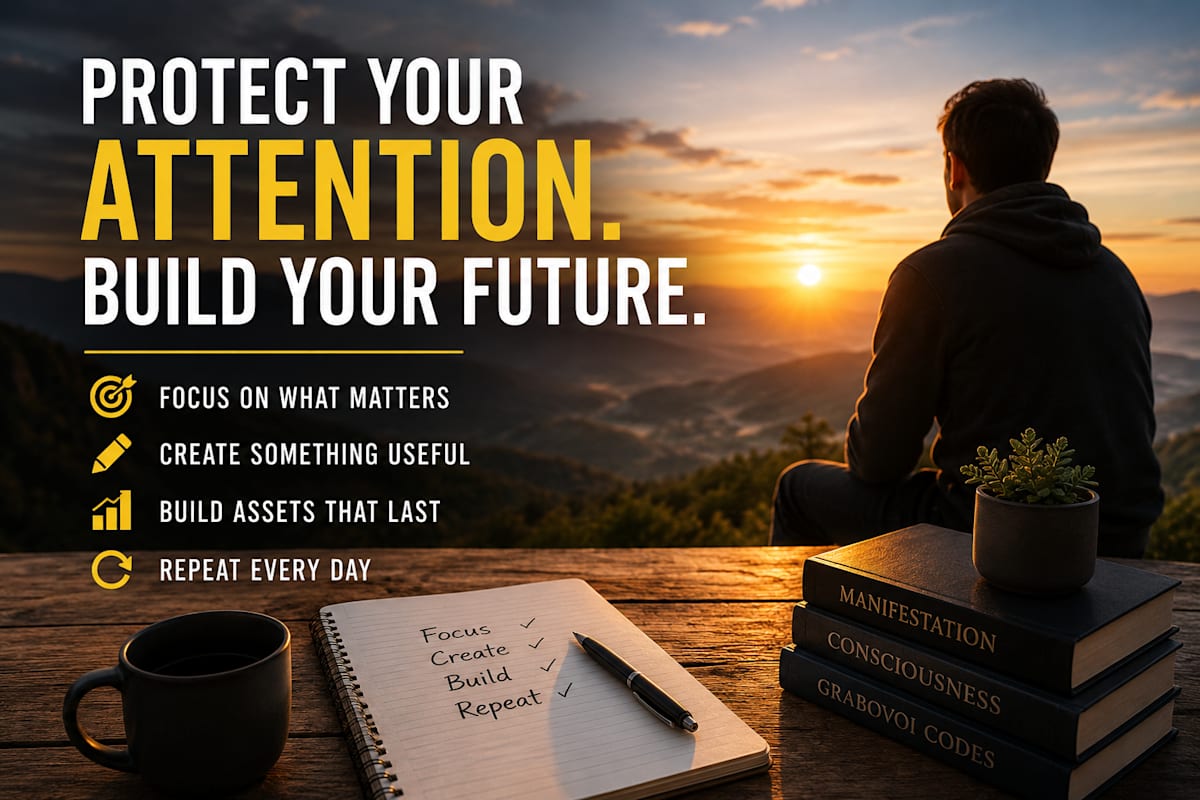
If I asked you what your most valuable asset is, you might say your health.
Or your family.
Or your career.
Maybe your savings.
They're all important.
But I think there's something even more valuable because it influences every one of those things.
Your attention.
Where your attention goes, your decisions usually follow.
Your habits follow.
Your emotions follow.
And eventually, your life follows.
We don't often think about attention because it feels invisible. Yet every day we're making thousands of tiny decisions about where to place it. Some are deliberate. Most aren't.
The question isn't whether your attention is valuable.
The question is who's directing it.
The World Wants Your Attention
Look around for five minutes.
Your phone vibrates.
A notification appears.
Someone sends a message.
A headline promises something shocking.
A video starts playing before you've even decided to watch it.
None of these things happen by accident.
Entire industries are built around capturing and holding your attention for as long as possible.
Their business model depends on it.
There's nothing inherently wrong with technology. I use it every day to write, publish books, connect with readers, and learn new ideas.
The problem begins when we stop choosing what deserves our attention and start reacting to whatever arrives next.
Reaction becomes our default setting.
And once that happens, creating anything meaningful becomes much harder.
Attention Is the Beginning of Every Achievement
Think about every worthwhile goal you've ever achieved.
Learning to drive.
Completing a qualification.
Writing a book.
Starting a business.
Improving your health.
Every one of them required sustained attention.
Not for an hour.
Not for a weekend.
Often for months or years.
Success isn't usually built through one extraordinary effort.
It's built through ordinary attention repeated consistently.
This is why people often overestimate what they can accomplish in a week but underestimate what they can accomplish in five years.
Small efforts compound when your attention stays focused long enough.
Your Brain Believes What You Feed It
One of the most fascinating things about the human brain is that it constantly looks for patterns.
Tell yourself often enough that you're unlucky, and you'll become remarkably good at spotting evidence that supports it.
Tell yourself you're always behind, and every comparison becomes proof.
On the other hand, if you decide to become someone who learns from setbacks instead of being defined by them, you'll start noticing opportunities that previously went unseen.
This isn't about pretending life is perfect.
It's about recognising that your internal dialogue influences your behaviour.
Behaviour influences outcomes.
That's where change begins.
Why Practical Manifestation Starts With Awareness
Manifestation has become one of the most misunderstood ideas in personal development.
Some people believe thoughts alone create reality.
Others dismiss the entire concept because of exaggerated claims.
I think the truth is much more practical.
Manifestation starts with awareness.
What am I thinking about most?
What assumptions am I carrying?
What decisions are those assumptions producing?
If I believe I can never improve my finances, I probably won't read books about money, ask better questions, or look for opportunities.
If I believe I can become better over time, I'm much more likely to take actions that support that belief.
The thought didn't magically change my bank account.
It changed my behaviour.
Behaviour changes results.
Build More Than You Consume
Here's an experiment worth trying.
At the end of today, ask yourself two questions.
How much did I consume?
How much did I create?
Maybe you watched three hours of videos.
Read social media for another hour.
Checked your email fifty times.
Now compare that with what you built.
Did you write anything?
Learn something new?
Help someone?
Improve your business?
Create a useful resource?
Consumption has its place.
Learning matters.
Rest matters.
Entertainment matters.
But if every day is mostly consumption, it's difficult to build anything meaningful.
The people who leave a lasting impact usually create more than they consume.
The Asset Mindset
One idea has transformed the way I approach work.
Build assets.
A book is an asset.
A useful article is an asset.
A course is an asset.
A website is an asset.
An email newsletter is an asset.
Even a thoughtful conversation can become an asset if it leads to a better idea.
Assets continue creating value after you've finished them.
That's why I enjoy writing books.
Months after publication, someone I've never met can discover an idea that helps them solve a problem or see something differently.
That's an incredible thing.
The effort happened once.
The value continues.
Small Decisions Shape Identity
People often wait until they feel like a different person before changing their habits.
In my experience, it works the other way around.
Identity grows from evidence.
Every time you write when you don't feel like writing, you're becoming a writer.
Every time you exercise, you're becoming someone who values health.
Every time you keep a promise to yourself, you're becoming someone you trust.
These moments seem small.
But together they quietly reshape the way you see yourself.
That's one of the reasons consistency matters so much.
It's not just producing results.
It's producing identity.
Why Simplicity Wins
There's a temptation to make personal growth complicated.
Complex morning routines.
Dozens of productivity apps.
Elaborate planning systems.
Sometimes those things help.
Often they become another distraction.
Simple usually wins.
Choose one important goal.
Protect time to work on it.
Reduce distractions.
Reflect regularly.
Repeat.
It isn't exciting.
But neither is brushing your teeth.
Some habits are valuable precisely because they become ordinary.
Three Questions Worth Asking Every Morning
Whenever I feel overwhelmed, I come back to three questions.
What deserves my attention today?
Not everything is equally important.
Choosing well matters.
What can I build today?
Even one page is progress.
One conversation can change a project.
One improvement can make tomorrow easier.
What can I ignore today?
This question might be the most powerful of all.
Not every notification deserves a response.
Not every argument deserves your energy.
Not every opinion deserves your attention.
Learning what to ignore is often just as valuable as learning what to pursue.
The Long Game
We live in a culture that celebrates speed.
Fast success.
Fast results.
Fast answers.
But the things that matter most still take time.
Trust.
Wisdom.
Health.
Mastery.
Meaningful relationships.
A body of work you're proud of.
These aren't built in dramatic moments.
They're built quietly.
One ordinary day after another.
The irony is that once enough of those days accumulate, people often call the result an overnight success.
They rarely see the years that came first.
Final Thoughts
You don't need to change your entire life this week.
You probably can't.
What you can do is protect your attention a little more carefully than you did yesterday.
Spend less time reacting.
Spend more time creating.
Read more than you scroll.
Build more than you consume.
Keep promises to yourself.
Focus on the next useful action instead of the perfect plan.
Those choices won't feel dramatic today.
In fact, they'll probably feel almost insignificant.
But that's how meaningful change usually begins.
Not with one extraordinary breakthrough.
With hundreds of ordinary decisions that slowly, quietly, and consistently shape the person you're becoming.
And in my experience, that's where the real work—and the real reward—has always been.